

Lucid Trading stands out in the futures prop firm space by offering profit splits of up to 90%, evaluation fees ranging from $100 to $760, and account sizes of up to $150,000. With both 1-step evaluation and instant funding options, the firm provides fast access to capital without strict time limits and a reachable 5% – 6% profit target.
By focusing exclusively on CME-listed futures contracts, Lucid Trading supports more than 10 professional trading platforms, including NinjaTrader, TradingView, and Quantower.
If you’re considering testing Lucid Trading under real market conditions, this is a good opportunity to join Lucid Trading with 40% off and evaluate whether its funding model aligns with your trading goals
| 💳 Challenge Fee | $100 – $760 |
| 👥 Account Types | 1-step and instant funding |
| 💰 Profit Split | 90% |
| 💵 Account Size | $25K – $150K |
| ⏱️ Time Limit | No time limit |
| 🎯 Profit Target | 5% – 6% |
| 📊 Trading Platforms | NinjaTrader, Tradovate, TradingView, Quantower, Sierra Chart, Jigsaw Trading, Bookmap |
| 🛍️ Asset Types | Futures Contracts |
Lucid Trading is a modern proprietary trading firm that launched in 2024. Operated under the legal entity Lucid Prop Ltd, the firm was built to provide a professional-grade bridge between retail traders and traditional proprietary desks.

The company is led by Lucid Trading CEO AJ, who envisioned a platform where transparency and speed are the core values. Unlike many competitors, Lucid Trading focuses exclusively on the CME futures contracts market, ensuring high liquidity and a regulated environment for all evaluation accounts.
The firm’s mission is to offer a step-by-step path for traders to move from testing strategies to trading with real capital. They aim to set a new standard by removing the ambiguity often found in the funded futures accounts industry.
Lucid Trading stands out as a high-performance bridge between retail traders and professional proprietary desks. By focusing solely on CME futures contracts, they offer a high-liquidity environment that removes many traditional hurdles found in forex-focused firms.
The headline feature of daily payouts is a genuine disruptor for those managing funded futures accounts. In my experience, allowing traders to access capital almost immediately reflects a level of transparency and trust that is rare in today’s industry.
However, this isn’t a playground for beginners. The Lucid Trading rules are logical but strict, especially regarding the consistency percentages. It feels like a partnership designed for the self-sufficient professional; the firm provides the institutional-grade capital. In return, they expect a repeatable, disciplined process rather than a few lucky home-run trades.
| Pros | Cons |
|---|---|
| Daily payouts are available in the LucidLive stage | Strict consistency rules (20% to 50%) |
| 90% profit split and FREE activation fees (Pro/Flex) | Buffer balance requirements for Pro withdrawals |
| End-of-day (EOD) drawdown is more trader-friendly | Relatively new firm (Launched late 2024) |
| Supports TradingView, NinjaTrader, and Quantower | No educational resources or mentorship |
| Instant funding option via LucidDirect | Daily Loss Limits on larger Pro accounts |
Lucid Trading offers three main funding pathways: Lucid Black, Lucid Flex, and Lucid Direct. This variety allows you to choose between a standard low-cost evaluation or gaining immediate access to capital without any testing phase.
All programs are geared toward reaching the LucidLive stage, where daily payouts become available. Traders enjoy a high 90% profit split and a streamlined setup process that allows for real-time account activation within minutes of purchase.
The Lucid Black plan is Lucid Trading’s premium funded account designed for serious futures traders who want larger capital, flexible rules, and fast payouts. With Lucid Black, you can trade up to $25K, $50K, or $100K account sizes with a 40% consistency requirement, no daily loss limits, and a scaling structure that increases your tradable size as you profit.
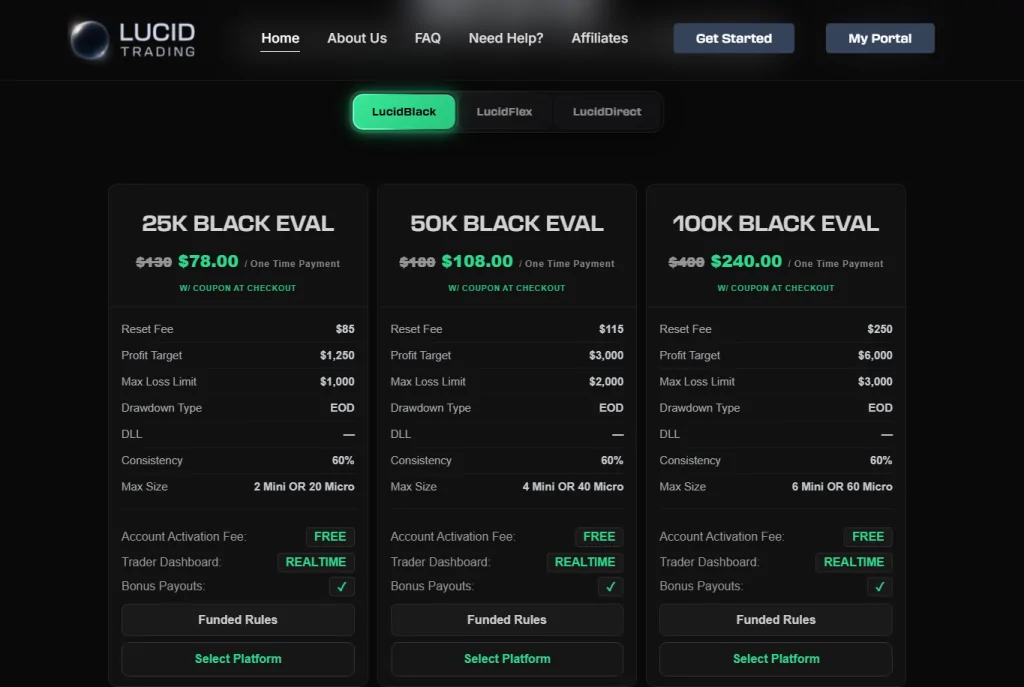
This plan allows eligible traders to earn real funded capital with a 90% profit split, withdraw earnings as soon as eligibility is met, and even target bonus payouts for exceeding profit goals.
Perfect for disciplined traders who want advanced trading flexibility, bigger payout potential, and a trader-first structure, Lucid Black offers a clear path to earning with real capital under transparent rules.
| Plan Type | Profit Target | Max Loss Limit (EOD) | Daily Loss Limit (DLL) | Max Contract Size | One-Time Fee |
|---|---|---|---|---|---|
| 25K | $1,250 | $1,000 | NONE | 2 Mini / 20 Micro | $78.00 |
| 50K | $3,000 | $2,000 | NONE | 4 Mini / 40 Micro | $108.00 |
| 100K | $6,000 | $3,000 | NONE | 6 Mini / 60 Micro | $240.50 |
The Lucid Flex plan is a 1-step evaluation designed for traders who want even more freedom than the Pro model provides. Like its counterpart, this pathway features a FREE account activation fee and focuses on the trader-friendly End of Day (EOD) drawdown system.

The core difference is that Lucid Flex has NO Daily Loss Limit (DLL) across any account size, whereas larger Pro accounts have strict daily caps. However, to maintain quality, theuation requires a 50% consistency rule, ensuring your profits are spread across multiple sessions.
Once you transition to a funded status, the consistency rule is removed entirely. Traders can focus on reaching their goals and securing a lucid trading payout by meeting a minimum of 5 days of profit (ranging from $100 to $250, depending on the account size).
| Plan Type | Profit Target | Max Loss Limit (EOD) | Daily Loss Limit (DLL) | Consistency Rule (Eval) | One-Time Fee |
|---|---|---|---|---|---|
| 25K | $1,250 | $1,000 | NONE | 50% | $70.00 |
| 50K | $3,000 | $2,000 | NONE | 50% | $91.00 |
| 100K | $6,000 | $3,000 | NONE | 50% | $157.50 |
| 150K | $9,000 | $4,500 | NONE | 50% | $241.50 |
Lucid Direct is the premier straight-to-funding pathway that allows you to skip the evaluation phase entirely. While it requires a higher upfront cost, you begin trading for real payouts from the very first day.
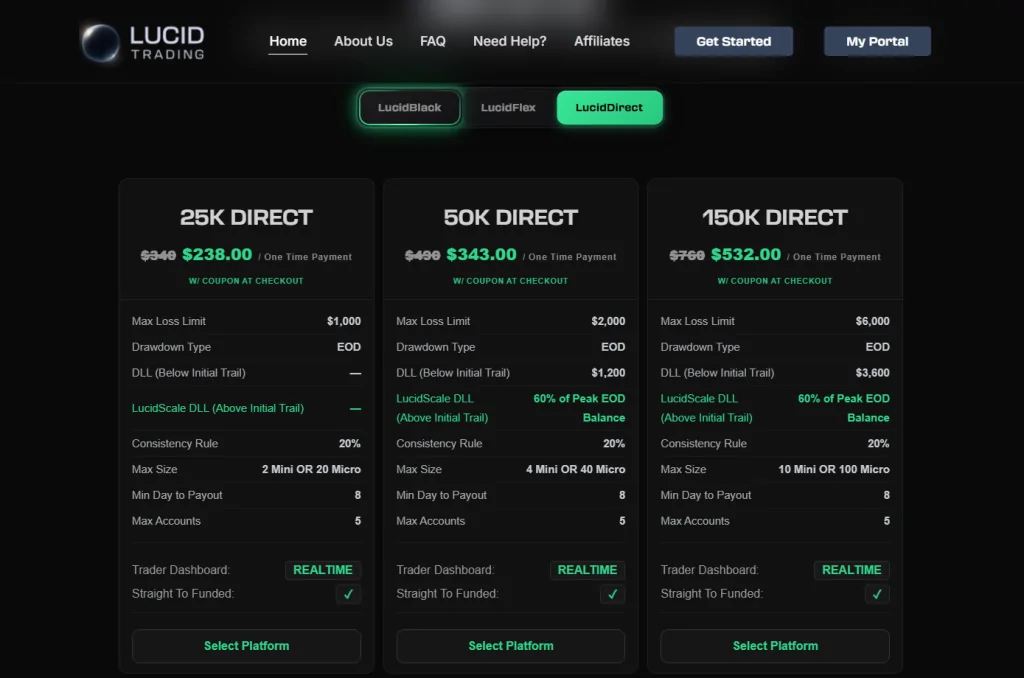
This program utilizes the End of Day (EOD) drawdown and introduces a 20% consistency rule to ensure long-term stability. You can manage up to 5 accounts simultaneously, making it an excellent option for scaling your capital quickly.
A unique feature here is the LucidScale DLL, which dynamically adjusts your daily loss limit based on your peak EOD balance once you are above the initial trail. The minimum days to payout is set at 8, ensuring you build a short track record before your first withdrawal.
| Plan Type | Max Loss Limit (EOD) | Daily Loss Limit (Below Trail) | Consistency Rule | Min Day to Payout | One-Time Fee |
|---|---|---|---|---|---|
| 25K | $1,000 | NONE | 20% | 8 | $238.00 |
| 50K | $2,000 | $1,200 | 20% | 8 | $343.00 |
| 150K | $6,000 | $3,600 | 20% | 8 | $532.00 |
Verdict on Lucid Trading funding programs
Choosing the right account type is the most critical decision for your journey with this proprietary trading firm. Each path serves a different psychological profile and level of market experience.
The lack of activation fees across the board makes Lucid Trading one of the most transparent firms in the industry. However, the 20% consistency rule on Direct accounts is quite strict, so ensure your strategy doesn’t rely on single home run trades.
The foundation of Lucid Trading rules is designed to mirror a professional environment rather than a restrictive fail-fast game. Success here depends on demonstrating a genuine market edge and maintaining a high level of risk management throughout the evaluation.
The firm operates on a partnership of trust, where they provide the capital and technology while you bring the discipline. Whether you are using evaluation accounts or a LucidDirect path, understanding the operational boundaries is vital for a smooth payout process.
These are the operational standards that apply to almost every account type within the Lucid Trading prop firm ecosystem.
Lucid Trading offers significant freedom for various strategies, making it a favorite for those who find other firms too restrictive.
To ensure the long-term sustainability of the firm, certain behaviors that exploit the simulated environment are strictly forbidden.
Verdict on Lucid Trading rules
The most impressive part of the Lucid Trading rules is the No Hard Breach policy on closing times. Most firms will fail your account instantly if you forget to close a trade by 4:00 PM, but Lucid simply flattens it for you, which is a massive stress reliever.
However, the consistency percentages are the real gatekeepers here. If you have one lucky day that makes up 60% of your profit, you will have to continue trading until that day fits within the allowed ratio. It effectively filters out lucky gamblers and rewards those with a repeatable, steady process.
In summary, the rules are fair, transparent, and logical. As long as you aren’t trying to game the simulated fill logic via microscalping, you will find the environment very supportive of professional growth.
The Lucid Trading payout system is the firm’s primary differentiator, focusing on providing traders with rapid access to liquidity. While most competitors enforce rigid 30-day windows, this platform offers a path to daily payouts once specific eligibility criteria are met.

Standard-funded accounts operate on a 90/10 profit split, allowing you to keep the vast majority of your gains. For those who reach the LucidLive stage, the split adjusts to 80/20, but provides much higher autonomy. Approved withdrawals are typically disbursed via Plaid or WorkMarket within two business days.
The scaling plan at Lucid Trading is a core component of their risk management strategy for funded futures accounts. It ensures that traders do not take on excessive leverage before proving they can maintain a stable, profitable balance.
This plan only applies to the funded phase; there is no scaling during the evaluation accounts stage. It is designed to grow with your success, allowing for larger position sizes as your simulated profits increase.
A critical detail for any Lucid Trading review is that these limits update at the end of each session. This means your tradable contract size will not shift in real-time during the trading day, providing a more stable execution environment.
| Simulated Profits | 25K Plan Limits | 50K Plan Limits | 100K Plan Limits | 150K Plan Limits |
|---|---|---|---|---|
| $0 – $999 | 1 Mini (10 Micros) | 2 Minis (20 Micros) | 3 Minis (30 Micros) | 4 Minis (40 Micros) |
| $1,000 – $1,999 | 2 Minis (20 Micros) | 3 Minis (30 Micros) | 4 Minis (40 Micros) | 5 Minis (50 Micros) |
| $2,000 – $2,999 | – | 4 Minis (40 Micros) | 5 Minis (50 Micros) | 6 Minis (60 Micros) |
| $3,000 – $4,499 | – | – | 6 Minis (60 Micros) | 8 Minis (80 Micros) |
| $4,500+ | – | – | – | 10 Minis (100 Micros) |
Attempting to circumvent these limits is a violation of the trading rules. The back-end systems track account balances closely, and repeated attempts to bypass the scaling plan may result in a formal account review.
Verdict on Lucid Trading scaling plan
Scaling plans are often viewed as a hurdle, but they act as a safety net for the trader. By tying contract size to profit, the firm prevents the one-trade blowup that often happens when a trader over-leverages a small account.
The decision to update limits at the end of the session rather than intraday is a major benefit. It prevents the confusing situation where your buying power suddenly drops while you are in the middle of a winning or losing trade.
The LucidFlex scaling plan is fair and rewards patience. However, if you are a power trader who wants full 10-minute contract capability on a $150K account immediately, you must first earn at least $4,500 in simulated profits to unlock the maximum position size.
Understanding the cost of doing business is vital for any professional trader. At Lucid Trading, the fee structure is transparent, with commissions applied to every trade on a per-side basis to reflect real-market conditions on CME futures contracts.
Because you are trading on centralized exchanges like CME, CBOT, NYMEX, and COMEX, the spreads are raw and market-driven. The firm does not add an artificial markup to the spreads, ensuring that you get the most accurate execution possible during your evaluation accounts phase.
Below is a detailed breakdown of the commission fees for the most popular assets:
| Symbol Category | Representative Symbols | Commission (Per Side) | Exchange |
|---|---|---|---|
| Equity Minis | ES, NQ, RTY, YM | $1.75 | CME/CBOT |
| Equity Micros | MES, MNQ, M2K, MYM | $0.50 | CME/CBOT |
| Currencies | 6A, 6B, 6E, 6J, 6S | $2.40 | CME |
| Energies | CL (Crude), QG (Gas) | $2.00 / $1.30 | NYMEX |
| Metals | GC (Gold), SI (Silver) | $2.30 | COMEX |
| Agriculturals | ZS, ZC, ZW | $2.80 | CBOT |
Verdict on Lucid Trading spreads & commission fees
The $1.75 commission for E-mini contracts is fairly standard across the prop trading industry. Where Lucid Trading truly stands out is its $0.50 commission rate for Micro contracts, making it especially cost-effective for traders who use a micro-scaling approach to manage risk with greater precision.
It is important to remember that these fees are deducted from your account balance in real time. For high-frequency scalpers, these costs can add up quickly and impact your ability to reach the profit target.
The fee structure is competitive and favors those who trade liquid indices and micros. However, currency and agricultural futures carry slightly higher costs ($2.40 – $2.80), so traders specializing in those niches should factor these overheads into their trading rules and overall strategy.
Lucid Trading provides exceptional flexibility by supporting multiple data feeds. This allows you to integrate your preferred trading platforms directly with your evaluation accounts for a seamless professional experience.
The firm currently offers three primary pathways: CQG, Rithmic, and the legacy Project X. However, users should note that Project X (LucidX) is being phased out. New purchases for LucidX end on December 31, 2025, with full termination scheduled for February 28, 2026.
Verdict on Lucid Trading platforms
The inclusion of TradingView via CQG is a massive win for modern traders. We recommend avoiding LucidX at this stage to prevent migration issues in 2026. For those needing deep market analysis, the Rithmic integration with Quantower offers the most robust professional environment.
Lucid Trading specializes exclusively in CME futures contracts, providing a transparent and regulated environment. This focus ensures that all funded futures accounts benefit from high liquidity and centralized exchange execution across all account types.
Traders have access to five major categories: Equities (S&P 500, Nasdaq), Metals (Gold, Silver), Energies (Crude Oil, Natural Gas), Interest Rates, and Agriculturals. This variety allows for diverse strategies across different market sectors during the evaluation accounts phase.
Leverage in futures is managed through max position size rather than fixed ratios like 1:100. Depending on your LucidPro or LucidFlex plan, you can trade multiple Minis or dozens of Micros, allowing for precise risk management based on your account’s drawdown limits.
Verdict on Lucid Trading instruments
The asset selection is excellent for dedicated futures specialists who value centralized transparency. While the lack of spot Forex or Crypto might deter some, the ability to trade Micro contracts with low commissions makes this firm an ideal place to master the CME markets with professional capital.
The support ecosystem at Lucid Trading is designed for high-speed efficiency, offering 24-hour support, 5 days a week. Traders can access assistance from Monday through Friday, with a dedicated team of real humans ready to help via the live chat feature.
Most technical inquiries receive a quick response within 10-15 minutes, which is a significant advantage during active market hours. Additionally, the Lucid Trading Discord community provides a vital space for peer-to-peer interaction and real-time updates among fellow futures traders.
A notable weakness of this prop firm, however, is the lack of structured educational resources. Unlike many competitors that offer mentorship or courses, Lucid Trading provides very little guidance. They clearly expect you to have already mastered your strategy before opening any evaluation accounts.
Verdict on Lucid Trading support & education
The firm is exceptionally responsive to technical issues, ensuring that your trading infrastructure remains stable. However, the total absence of formal educational content makes it a difficult environment for total beginners to navigate without external help.
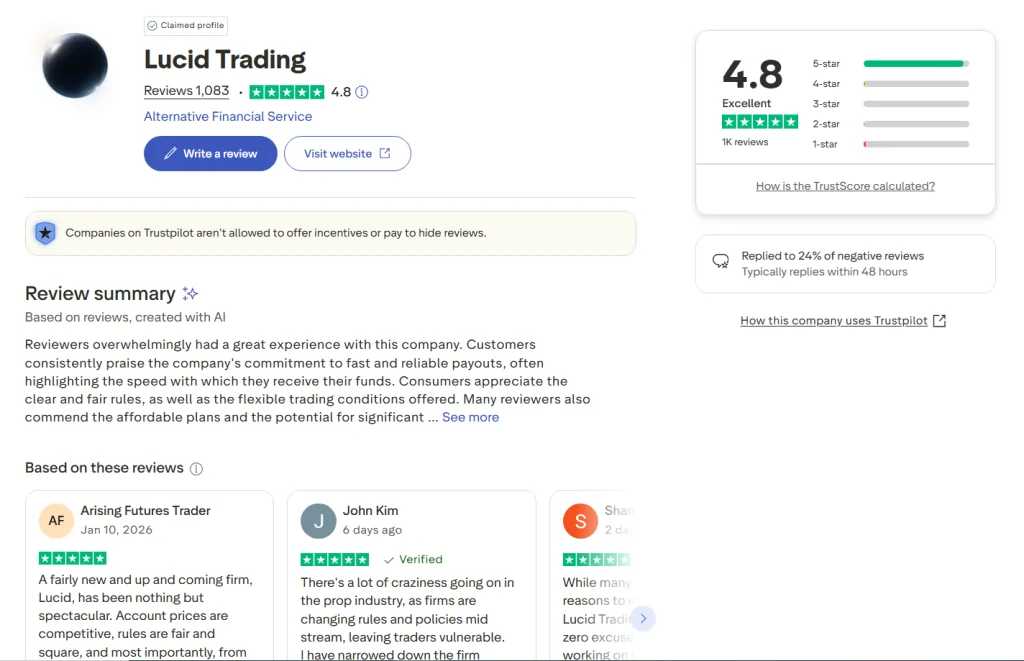
Public sentiment regarding this firm is overwhelmingly positive, with Lucid Trading currently holding an impressive 4.8 Excellent rating on Trustpilot. With over 1000 reviews submitted, the consensus highlights a high level of trust and transparency within the community.
Analysis of recent feedback shows that most participants are satisfied with the price stability and the firm’s ability to provide a fun yet professional environment. The majority of traders appreciate the simple rules for passing evaluation accounts without hidden traps.
Getting started with a funded futures account path is designed to be a frictionless process. By following a few simple steps, you can move from a retail environment to a professional proprietary trading setup in under 30 minutes.
The registration process follows these key milestones:
Follow the detailed breakdown below to ensure your account is set up correctly for your first profit target attempt.
Before purchasing an account, you must verify your eligibility based on your residency and citizenship. Lucid Trading adheres to strict international financial regulations, which means individuals from certain jurisdictions are prohibited from using its services.
If you reside in any of the Lucid Trading restricted countries listed below, you will not be able to pass the mandatory identity verification required for a Lucid Trading payout. Attempting to bypass these geo-restrictions is a violation of the firm’s trading rules.
| A – C | D – J | K – N | P – S | T – Z |
|---|---|---|---|---|
| Afghanistan | Donetsk | Kenya | Pakistan | Tanzania |
| Albania | Ecuador | Kherson | Panama | Turkey |
| Algeria | Ethiopia | Kosovo | Papua New Guinea | Trinidad and Tobago |
| Angola | Ghana | Laos | Philippines | Tunisia |
| Bahamas | Guinea | Lebanon | Russia | Uganda |
| Barbados | Haiti | Liberia | Senegal | Ukraine |
| Belarus | Iceland | Libya | Serbia | Vietnam |
| Bosnia & Herz. | Indonesia | Lithuania | Sevastopol | Venezuela |
| Bulgaria | Iran | Luhansk | Slovenia | Yemen |
| Burkina Faso | Iraq | Mali | Somalia | Zimbabwe |
| Burma/Myanmar | Jamaica | Mauritius | South Africa | |
| Botswana | Mongolia | South Sudan | ||
| Burundi | Montenegro | Sri Lanka | ||
| Cambodia | Morocco | Sudan | ||
| Central African Rep. | Mozambique | Syria | ||
| Côte d’Ivoire | Namibia | |||
| Crimea | Nicaragua | |||
| Cuba | Nigeria | |||
| Congo (Brazzaville) | North Korea | |||
| Congo (Kinshasa) | North Macedonia |
We highly recommend checking the official Lucid Trading website periodically, as this list can change based on evolving global financial laws and proprietary trading regulations.
Evaluating Lucid Trading alongside established peers reveals its positioning in the competitive futures landscape. Each firm offers a different balance of challenge fees and rules to attract diverse types of professional traders.
The following data highlights how these firms structure their funded futures accounts. Focus on these specific metrics to determine which environment best supports your risk management goals and trading style.
| Criteria | Lucid Trading | Take Profit Trader | My Funded Futures | Topstep |
|---|---|---|---|---|
| Challenge Fee | $60 – $532 | $150 – $360 | $77 – $477 | $49 – $149 |
| Account Types | 1-step, and instant funding | 1-step | 1-step | 2-step |
| Profit Split | 90% | 80% – 90% | 80% | 90% – 100% |
| Account Size | $25K – $150K | $25K – $150K | $50K – $150K | $50K – $150K |
| Time Limit | No time limit | No time limit | No time limit | No time limit |
| Profit Target | 5% – 6% | 6% | 6% | 6% |
Choosing between these firms depends on whether you value historical reputation or modern payout flexibility. Each platform caters to a slightly different segment of the futures market.
While Topstep offers the most history, Lucid Trading provides a more modern and flexible payout structure. For traders who have already mastered their trading rules, the 90% split and lack of activation fees at Lucid make it a superior choice for maximizing net take-home pay.
This Lucid Trading review highlights a firm that offers a modern approach to futures funding with competitive profit splits up to 90%. To answer the main question: yes, daily payouts are real, but are primarily accessible once traders reach specific stages, like LucidLive. Success depends on understanding the unique requirements tied to each funding pathway.


